
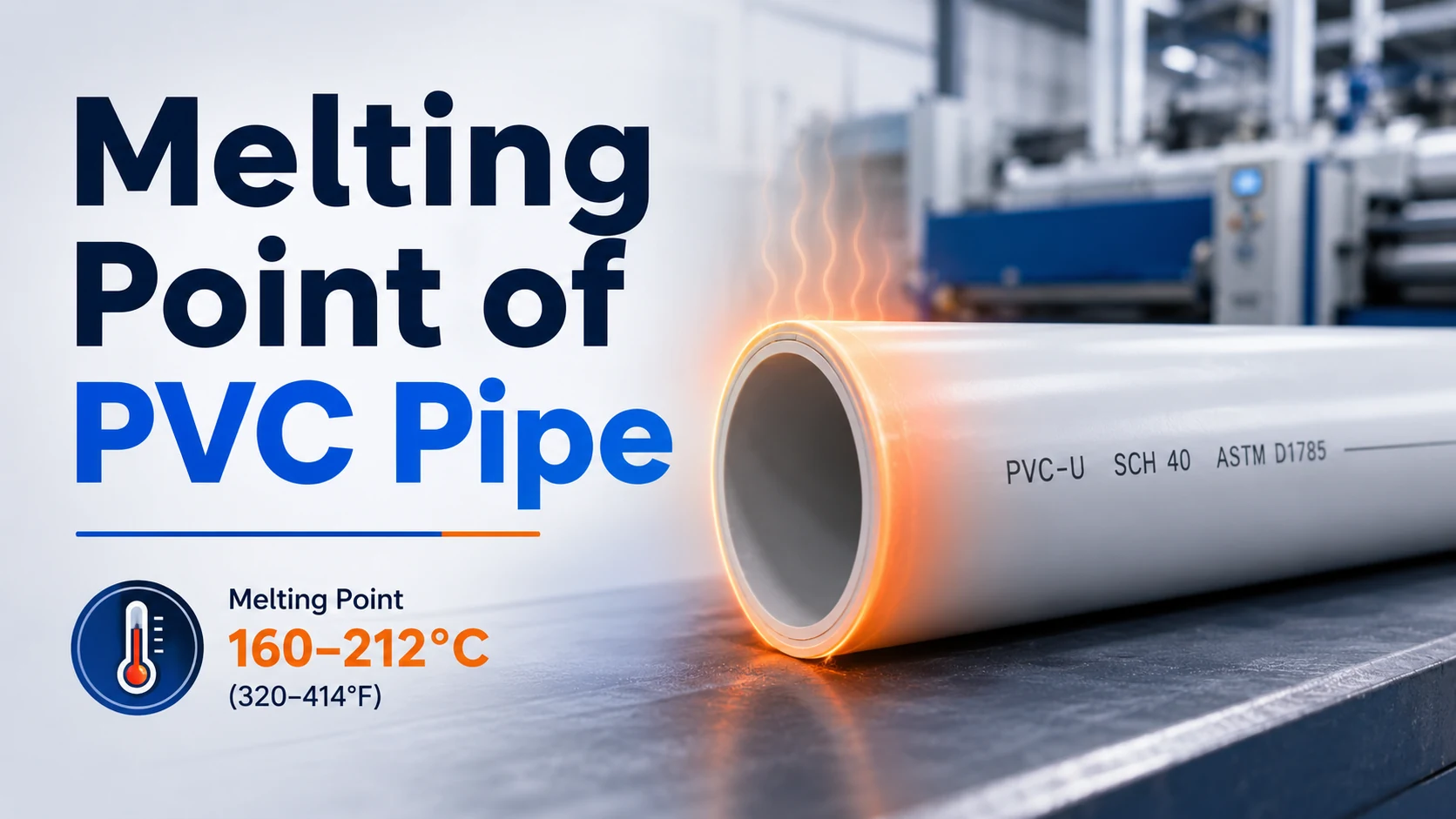
Melting Point of PVC Pipe: Temperature Ratings, Softening, and Safe Use Guide
The melting point of pvc pipe is usually discussed as a range, not one clean number. Rigid PVC does not melt like ice or aluminum. It softens first, loses stiffness as temperature rises, can be processed in the roughly 160-212°C range, and may begin to degrade if it is overheated. For pipe users, the more important number is often not the processing melt range. It is the safe working temperature and pressure rating of the pipe in service.
This guide explains the difference between PVC melting, softening, glass transition, heat deflection, and pipe temperature rating. It is written for engineers, buyers, maintenance teams, product designers, and anyone comparing PVC pipe with CPVC, PP, PE, nylon, ABS, or metal tubing. If you are choosing PVC for a fluid line, fixture, machined plastic component, or custom pipe-related part, this distinction can prevent a costly mistake.
Quick Answer
The melting point of pvc pipe is commonly described as about 160-212°C, or 320-414°F, depending on formulation, plasticizer level, stabilizer package, and test method. However, rigid PVC pipe should not be used anywhere near that temperature. Standard PVC pressure pipe is commonly limited to about 60°C, or 140°F, for continuous service, and pressure capacity drops as temperature rises. PVC also begins to soften far below its processing temperature, so a pipe can deform, sag, leak, or lose pressure rating long before it looks melted.
PVC Temperature Terms: Do Not Mix These Up
| Term | Approximate Meaning | Why It Matters |
|---|---|---|
| Glass transition | PVC shifts from rigid/glassy toward softer behavior around the high double-digit °C range. | Stiffness and impact behavior change before the pipe is close to melting. |
| Vicat softening point | A test value showing when a loaded needle penetrates softened plastic. | Useful for comparing formulations, but not the same as safe service temperature. |
| Heat deflection temperature | Temperature where plastic bends under a specified load. | Important for brackets, pipe supports, fixtures, and loaded plastic parts. |
| Processing melt range | Often discussed around 160-212°C for PVC processing. | Relevant to extrusion, forming, welding, and manufacturing, not normal pipe use. |
| Continuous service rating | Common PVC pipe service limit around 60°C / 140°F. | This is the number designers should respect for water and pressure applications. |
Why PVC Pipe Does Not Have One Simple Melting Point
PVC is a thermoplastic, but commercial PVC pipe is not pure polymer in a laboratory jar. It contains stabilizers, lubricants, pigments, impact modifiers, processing aids, and sometimes other additives. Rigid PVC pipe, flexible PVC hose, electrical conduit, drainage pipe, and PVC sheet may behave differently under heat. That is why you will see different values online for PVC melting point, softening point, and processing temperature.
Another issue is that PVC can thermally degrade if overheated. Instead of politely becoming a clean liquid like some simple thermoplastics, PVC can discolor, release acidic fumes, lose mechanical properties, and become unsafe to process without proper controls. This is why manufacturers use stabilizers and carefully controlled extrusion temperatures. For a finished pipe in service, the practical rule is simple: do not design by the high processing range. Design by the pipe rating, pressure derating table, and chemical exposure conditions.
Melting Point vs Working Temperature of PVC Pipe
The most common design error is to see a PVC melting range near 160-212°C and assume the pipe can safely carry hot fluid anywhere below that number. That is not correct. A PVC pipe can lose strength and stiffness at much lower temperatures. The pipe wall may become easier to deform, joints may be stressed, supports may sag, and pressure capacity can drop.
For many rigid PVC pressure pipe systems, 73°F / 23°C is the baseline temperature for pressure rating. As the fluid temperature rises, the pressure rating is reduced. Around 140°F / 60°C, standard PVC is typically near the upper limit of continuous service. Above that range, CPVC, polypropylene, PVDF, stainless steel, copper, or another material may be safer depending on fluid, pressure, code requirements, and installation environment.
Typical PVC Pipe Temperature and Pressure Behavior
| Temperature Zone | What Happens to PVC Pipe | Design Advice |
|---|---|---|
| Room temperature | Pipe holds rated pressure according to its schedule, standard, and manufacturer data. | Good for cold water, drainage, chemical lines, guards, and many non-pressure parts. |
| Warm service | Strength and stiffness begin to fall; pressure rating should be derated. | Check the pipe manufacturer temperature correction factor. |
| Near 60°C / 140°F | Often the practical continuous service upper limit for standard PVC pipe. | Use caution; consider CPVC or metal for hot water and high pressure. |
| Above normal service range | Softening, deformation, joint stress, and leak risk increase. | Do not rely on melting point; choose a higher-temperature material. |
| Processing range | PVC can be extruded, formed, or welded under controlled industrial conditions. | Requires ventilation, temperature control, tooling, and material-specific knowledge. |
What Happens If PVC Pipe Gets Too Hot?
Heat damage does not always look dramatic at first. PVC pipe may warp, ovalize, sag between supports, or lose dimensional stability around a joint. In pressure systems, a pipe that looks visually acceptable can still have reduced pressure capacity. Solvent-cemented joints can also become vulnerable if the pipe is exposed to heat, stress, and chemical attack at the same time.
Overheating during processing is a different risk. If PVC is heated too aggressively, it can discolor and degrade. This is one reason PVC extrusion and fabrication require controlled temperature windows. For field work, never use open flame as a casual forming method. Local overheating can damage the pipe wall before the entire part becomes visibly soft.
PVC-U, CPVC, and Flexible PVC: Which One Are You Talking About?
When people ask about the melting point of pvc pipe, they often mean rigid white PVC pipe, also called PVC-U or unplasticized PVC. PVC-U is stiff, economical, corrosion resistant, and widely used in cold water, drainage, conduit, and chemical applications. Flexible PVC behaves differently because plasticizers reduce rigidity and change temperature behavior.
CPVC is chlorinated PVC. It is designed for higher temperature service than standard PVC and is often considered for hot water applications. CPVC does not make every problem disappear, but it expands the temperature window. If your application involves hot water, steam-adjacent equipment, heated chemical lines, or elevated ambient temperature, CPVC or another engineering plastic may be a better starting point than standard PVC.
Can PVC Pipe Be Heat Formed?
PVC pipe can be heat formed, but it should be done carefully. Controlled heating can allow bending or shaping, especially in non-pressure applications such as guards, ducts, light-duty fixtures, and prototypes. The key word is controlled. Uneven heating can thin the wall, create ovality, reduce strength, and leave internal stress. For pressure pipe, heat bending is usually not a casual substitution for proper fittings unless the application standard and manufacturer guidance allow it.
For repeatable parts, a fixture and temperature-controlled heat source are better than guesswork. If the part needs dimensional accuracy, CNC machining from PVC sheet, rod, or plate may be more predictable than bending pipe. If the part is structural or loaded, heat deflection and creep should be reviewed before choosing PVC.
CNC Machining PVC: What Buyers Should Know
PVC can be CNC machined into plates, guards, spacers, insulators, pipe adapters, manifolds, light-duty fixtures, and corrosion-resistant plastic parts. It is generally easier to machine than many high-performance engineering plastics, but it still needs the right tool geometry and chip control. Sharp tools reduce heat. Good chip evacuation prevents rubbing. Conservative feeds can avoid melting at the cutting edge. For thin walls or pipe-shaped parts, workholding is often the main challenge.
The melting point of pvc pipe matters in machining because heat buildup can smear edges, soften local areas, and affect dimensional accuracy. If a cut starts to look glossy, sticky, or melted, the process is generating too much heat. Tool sharpness, feed rate, spindle speed, cutter engagement, coolant or air blast, and fixturing should be reviewed. PVC also deserves dust and fume awareness, especially if heat is high. Do not machine PVC as if it were aluminum.
When PVC Pipe Is a Good Material Choice
PVC pipe is useful because it is economical, corrosion resistant, lightweight, easy to source, and simple to join. It is a good fit for many cold water lines, drainage systems, chemical-resistant non-metallic piping, electrical conduit, protective sleeves, prototype fixtures, and low-temperature applications. It is also easy to cut, drill, bond, and machine compared with metals.
Choose PVC when the service temperature is controlled, the pressure rating is properly derated, the chemical environment is compatible, and the mechanical load is modest. For non-pressure guards, sleeves, and prototypes, PVC can be a cost-effective option. For high-temperature, high-pressure, outdoor UV-heavy, impact-heavy, or safety-critical systems, confirm the grade and standard carefully before choosing it.
When Not to Use PVC Pipe
Do not use standard PVC pipe for applications that exceed its service temperature rating, especially hot water pressure lines where CPVC or metal may be required. Avoid PVC where fire behavior, smoke, high impact, unsupported span, continuous mechanical load, UV exposure, or aggressive chemicals create risk. Also avoid using the processing melt range as a design limit. A pipe that is still far below its nominal melting range can already be unsafe for pressure service.
In industrial equipment, another common mistake is routing PVC pipe near heaters, ovens, compressors, hot process tanks, steam lines, or sun-exposed rooftops without considering ambient heat. The fluid may be cool, but the pipe wall can still experience elevated temperature. Supports, expansion, and pressure derating should be checked together.
Common Mistakes About the Melting Point of PVC Pipe
The first mistake is treating 160-212°C as a use temperature. That range belongs to processing discussions, not normal pipe service. The second mistake is assuming a pipe is safe just because it has not visibly melted. Mechanical performance can fall long before the material looks damaged. The third mistake is ignoring pressure. A hot, non-pressure sleeve and a hot pressure line are not the same problem.
The fourth mistake is copying a temperature from a generic PVC material page without checking the actual pipe standard. Schedule 40, Schedule 80, drainage pipe, conduit, sheet, rod, clear PVC, gray PVC, and flexible PVC can have different expectations. The fifth mistake is forgetting installation details. A pipe that is acceptable in an indoor shaded line may behave differently near sunlight, a hot machine frame, a boiler room, or a poorly ventilated enclosure.
Procurement Notes: What to Ask Before Buying PVC Pipe or Parts
For purchasing teams, the best RFQ is specific. Ask for the PVC grade, pipe schedule or wall thickness, standard, outside diameter, pressure class, color, UV exposure requirement, and chemical compatibility. If the pipe will be cut or machined into adapters, collars, spacers, or fixtures, share the drawing and explain which dimensions are critical. PVC can be economical, but guessing material and tolerance requirements often creates rework.
For custom parts, also tell the supplier whether the PVC part will touch water, oil, coolant, cleaning chemicals, food equipment, electrical equipment, or heated machinery. If the part will be glued, threaded, pressed into an assembly, or held by clamps, those interfaces affect material choice and machining strategy. The most useful question is not only “What is the melting point?” but “Will this part stay stable at my real operating temperature, load, and environment?”
That extra context helps the factory choose safer fixturing, cleaner cutting parameters, and a more realistic inspection plan.
Material Alternatives to PVC Pipe
| Need | Possible Alternative | Reason |
|---|---|---|
| Higher hot water temperature | CPVC, copper, stainless steel | Better high-temperature service than standard PVC. |
| Higher impact toughness | ABS, HDPE, nylon, polycarbonate | Depends on temperature, load, and chemical exposure. |
| High chemical resistance | PP, PVDF, PTFE, stainless steel | Useful for aggressive fluids or higher temperatures. |
| Precision machined plastic parts | Acetal, nylon, PTFE, PEEK, PVC sheet | Choose based on tolerance, wear, heat, and friction. |
Design Checklist for PVC Pipe Near Heat
- Confirm whether the material is PVC-U, CPVC, flexible PVC, or another formulation.
- Use the pipe manufacturer’s pressure-temperature derating chart.
- Check fluid temperature, ambient temperature, nearby heat sources, and sun exposure.
- Review support spacing because hot PVC can sag more easily.
- Do not field-bend pressure pipe unless the standard and manufacturer guidance allow it.
- For machined PVC parts, control tool heat and avoid rubbing.
- For hot or safety-critical systems, compare CPVC, PP, PVDF, stainless steel, or copper.
Related DAXIN Services
DAXIN supports CNC machining services for plastic and metal parts, including engineering plastic prototypes, pipe adapters, fixture plates, insulating blocks, brackets, housings, and low-volume custom components. Useful related resources include plastic machining failure control, polycarbonate vs acrylic CNC machining, nylon CNC machining, PTFE CNC machining, and CNC machining tolerances.
FAQ
What is the melting point of pvc pipe?
The melting point of pvc pipe is usually given as a broad processing range around 160-212°C, or 320-414°F. Standard PVC pipe should not be used near that temperature. Its safe continuous service temperature is much lower.
At what temperature does PVC pipe soften?
PVC begins losing stiffness well below its processing melt range. Softening depends on formulation and test method, but the practical lesson is that pressure rating and shape stability decline as temperature rises.
Can PVC pipe handle boiling water?
Standard PVC pipe is not a good choice for boiling water. Boiling water is about 100°C / 212°F, above the usual continuous service range for standard PVC pipe. CPVC or metal pipe is normally considered for hotter water applications.
Is CPVC better than PVC for heat?
Yes, CPVC is generally better for higher-temperature water service than standard PVC. The correct choice still depends on pressure, fluid chemistry, code requirements, and manufacturer rating.
Can PVC be CNC machined?
Yes. PVC sheet, rod, and some pipe-related blanks can be CNC machined. Use sharp tools, good chip evacuation, careful fixturing, and heat control to avoid melted edges or dimensional movement.
CTA: Upload Your CAD File / Get a Quote
If you need a PVC adapter, plastic fixture, pipe-related component, insulating block, machined plastic prototype, or a metal replacement for a high-temperature pipe part, upload your CAD file and drawing to DAXIN. We can review material, tolerance, temperature exposure, machining risk, surface finish, and quantity, then provide a practical quote.
Research Notes
This article was informed by public material and pipe-temperature discussions from Baosheng Industry, TiRapid, and Polyfab Online, then rewritten from a DAXIN CNC machining and material-selection perspective.