
CNC machining HDPE looks easy because the material is soft, but that softness is exactly why buyers often get parts with fuzzy edges, unstable dimensions, warped plates, and weak threads. HDPE cuts quickly compared with metals, yet it does not behave like aluminum or acetal. It moves under clamp force, expands with heat, flexes under cutting pressure, and can leave stringy chips if tool geometry is wrong.
This guide explains CNC machining HDPE from a practical manufacturing point of view. It covers machinability, tolerances, burr control, workholding, tool selection, thin walls, threaded features, surface finish, cost, and when HDPE is a smart material choice. The goal is simple: make HDPE parts that are useful in real assemblies, not just clean-looking blocks on a quote page.
Quick Answer
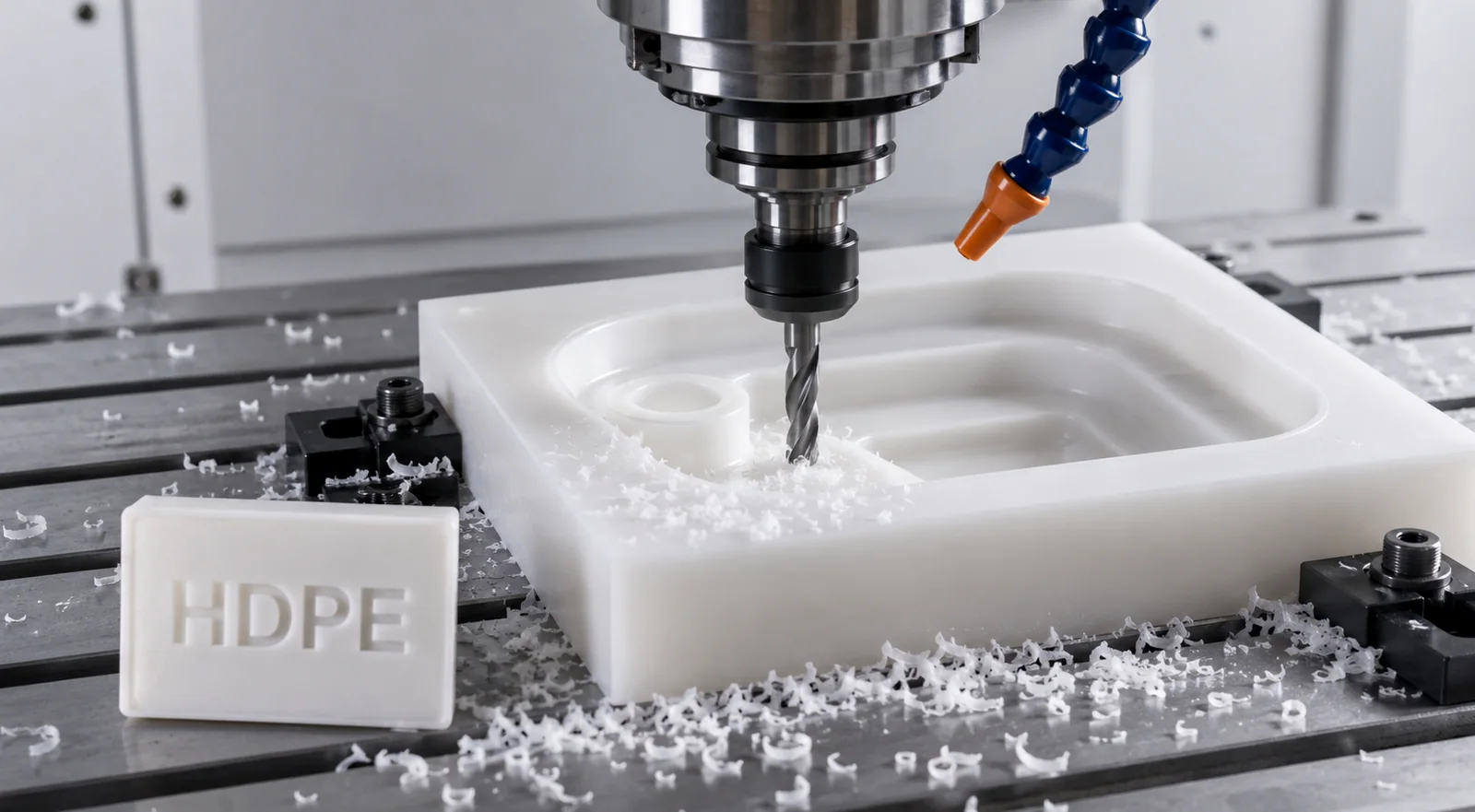
HDPE is a machinable engineering plastic with excellent chemical resistance, low moisture absorption, good impact resistance, low friction, and a relatively low cost. It is commonly used for wear pads, guide rails, fixtures, food processing parts, liners, spacers, bushings, tanks, plates, and custom plastic components. The main CNC machining risks are burrs, thermal movement, clamping deformation, poor thread strength, and dimensional instability in thin or large parts. For best results, use sharp tools, positive rake geometry, controlled heat, light clamping, generous radii, realistic tolerances, and clear deburring requirements.
HDPE Machining Reference Table
| Factor | HDPE Behavior | Machining Advice |
|---|---|---|
| Machinability | Easy to cut, but soft and flexible | Use sharp tools and avoid rubbing |
| Heat response | Can soften and expand | Control feed, chip evacuation, and dwell |
| Burrs | Often leaves fuzzy edges | Specify clean edge break and deburring |
| Tolerance | Less stable than metal | Avoid unnecessarily tight tolerances |
| Threads | Low thread strength compared with metal | Use inserts or coarse threads when needed |
| Surface finish | Can show tool marks or smear | Use sharp cutters and stable workholding |
What Is HDPE?
HDPE stands for high-density polyethylene. It is a lightweight thermoplastic known for toughness, chemical resistance, low moisture absorption, and low friction. Compared with many engineering plastics, HDPE is economical and available in sheets, rods, tubes, and blocks. It is often selected when the part needs to slide, resist chemicals, survive impact, or operate in a wet environment.
In CNC machining, HDPE is not chosen for high stiffness or high-temperature strength. It is chosen when a buyer needs a tough, slippery, corrosion-resistant, cost-effective plastic part. This makes it useful for guide rails, wear strips, cutting boards, packaging machinery components, marine parts, food-contact fixtures, chemical tank accessories, conveyor components, and protective pads.
Why HDPE Is Easy and Difficult at the Same Time
HDPE is easy because it does not require heavy cutting force. Tools enter the material smoothly, spindle load is low, and cycle time can be fast. It is difficult because it is soft, elastic, and sensitive to heat. A part can spring away from the cutter, move under clamps, or change dimension after it is released from the fixture.
This is the core difference between machining HDPE and machining metal. In aluminum, the cutter is usually fighting material strength. In HDPE, the cutter is often fighting material movement. If the process ignores that movement, the finished part may measure differently on the bench than it did while clamped in the machine.
Best Applications for CNC Machined HDPE
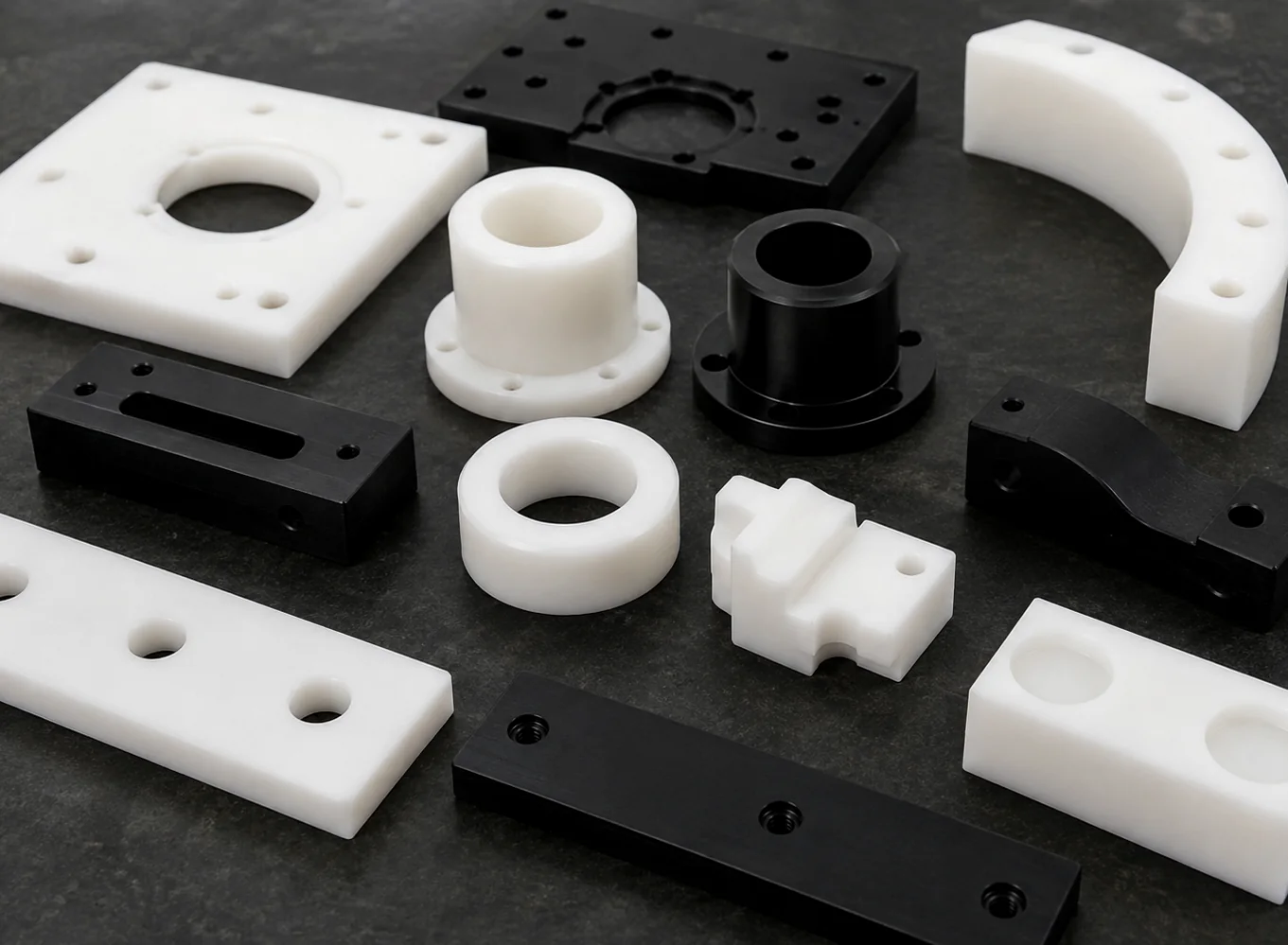
HDPE is a good choice for parts that need impact resistance, sliding contact, moisture resistance, chemical resistance, and moderate precision. Common examples include conveyor wear strips, chain guides, food processing fixtures, bottle handling rails, packaging machine guides, marine blocks, equipment liners, spacers, pads, simple bushings, low-load rollers, and custom brackets that do not need high stiffness.
It is especially useful where metal would corrode, scratch mating surfaces, create too much noise, or require unnecessary weight. HDPE can also be easier to clean than some other materials, depending on the environment and finish requirement.
When HDPE Is the Wrong Choice
HDPE is not ideal for high-load structural parts, tight bearing fits, high-temperature environments, thin precision walls, small fine-pitch threads, or parts that must hold metal-like tolerances. If the design requires high stiffness, acetal may be better. If it requires higher temperature resistance, nylon, PEEK, PTFE, or another engineering plastic may be more appropriate depending on the load and environment.
Buyers sometimes choose HDPE because it is inexpensive, then expect it to behave like a precision engineering plastic. That usually creates frustration. The material is excellent when used for the right job, but it is not a substitute for every plastic. DAXIN’s guide to CNC machining engineering plastics is a useful comparison point when material choice is still open.
Tooling for HDPE
Sharp tools matter more than expensive tools. HDPE responds well to cutters with high positive rake, polished flutes, and geometry that shears cleanly instead of pushing the material. Dull tools rub and heat the plastic. Once heat builds up, chips can smear, edges can fuzz, and dimensions can drift.
Single-flute and two-flute tools are often useful because they create room for large plastic chips to evacuate. For deep pockets or slots, chip packing is a serious risk. If chips stay in the cut, they can melt, weld to the edge, scratch the surface, or make the cutter deflect. Air blast is often more helpful than flood coolant, although the best method depends on the part and machine setup.
Speeds, Feeds, and Heat Control
The right speed and feed depend on tool diameter, machine rigidity, part geometry, and stock form. The practical rule is to cut clean chips, not dust and not melted strings. If the cutter creates powder, it may be rubbing instead of cutting. If it creates long melted strands, heat or chip evacuation may be poor.
HDPE can be machined at relatively high feed rates, but the process should avoid dwelling in one spot. Long pauses, repeated spring passes, and rubbing at the bottom of a pocket can create heat. Heat control is not only about surface finish. It affects final size because HDPE has higher thermal expansion than metals.
Workholding and Clamping
Workholding is one of the biggest differences between HDPE and metal. Because HDPE is soft, excessive clamping force can distort the stock. The part may look correct while clamped and then relax after removal. This is especially common with thin plates, long strips, large pockets, and parts with asymmetric material removal.
Better workholding uses broad support, soft jaws, vacuum fixtures, sacrificial plates, tabs, or balanced clamping where appropriate. The goal is to hold the part securely without crushing it into a temporary shape. For parts with flatness requirements, machining strategy and support are as important as the nominal tolerance.
Tolerance Expectations
HDPE can be machined accurately enough for many functional parts, but it should not be quoted like stainless steel or aluminum. Tight tolerances may be possible on small, thick, well-supported features, but large plastic plates and thin walls are less predictable. Temperature, clamping, moisture exposure, stock stress, and inspection timing can all affect measured size.
A smart drawing separates critical features from non-critical features. For example, a dowel hole, mounting slot, or mating bore may need control, while an outside profile or clearance pocket can use a looser tolerance. This helps reduce cost and avoids false precision. For broader planning, see DAXIN’s CNC machining tolerances guide.
Burrs and Edge Quality
HDPE burrs are different from metal burrs. They are often soft, stringy, and flexible. They may fold over instead of breaking away cleanly. A part can look acceptable from a distance but still have small fuzz around holes, slots, pockets, and milled edges. Those burrs can interfere with assembly, cleaning, sliding contact, or cosmetic acceptance.
The best approach is to prevent burrs with sharp tools and correct cutting direction, then specify the final edge requirement clearly. A vague “deburr all edges” note may not be enough if the part is used in food equipment, sliding machinery, or a visible assembly. DAXIN’s guide to CNC deburring and edge break explains why edge condition should be treated as a functional feature.
Holes, Slots, and Pockets
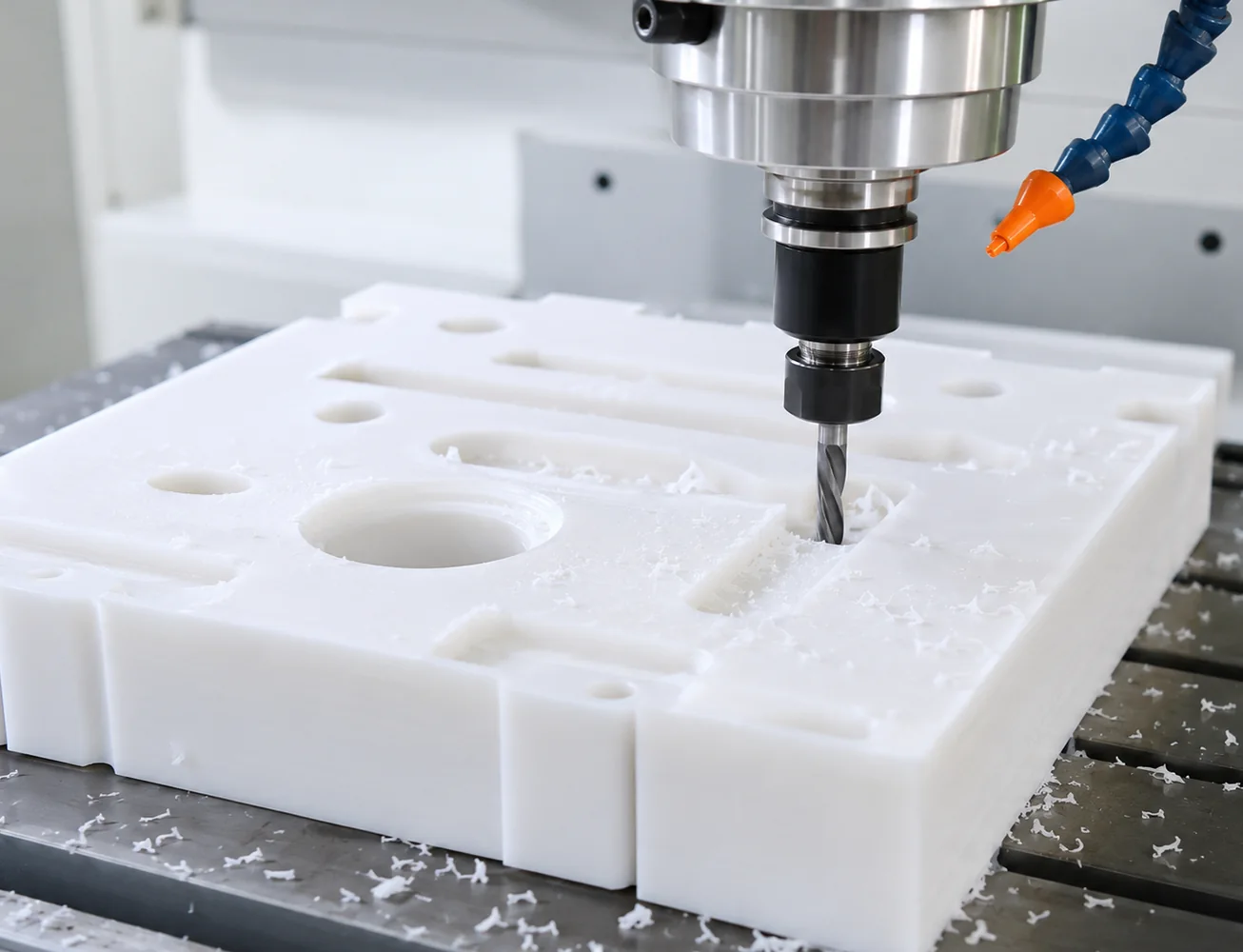
Drilled holes in HDPE can close slightly, show fuzzy entry edges, or vary if the drill rubs. Reaming, boring, or interpolating holes may be better for controlled fits. Slots and pockets need enough cutter clearance so chips do not pack along the wall. Long narrow slots can flex during machining, especially near thin sections.
For mounting holes, avoid designing them too close to the edge unless the load is low. HDPE can creep under long-term load, so bolt preload and washer area matter. When the part uses a bolt pattern, hole position still matters, but clearance and material flexibility must be considered together. Related reading: CNC hole position tolerance.
Threads in HDPE
Internal threads can be machined in HDPE, but they are not as strong or stable as metal threads. Fine threads, small diameters, repeated assembly, or high torque can damage the material. Coarse threads usually perform better. For stronger fastening, threaded inserts, through bolts, metal bushings, or larger engagement lengths may be better choices.
Thread design should consider the real assembly: how often the screw is removed, whether the part sees vibration, whether the load is constant, and whether creep matters. If the part needs reliable threaded holes, DAXIN’s guide to CNC threaded holes is a useful reference.
Surface Finish
HDPE usually does not achieve a shiny machined finish like polished acrylic or metal. The surface may show cutter paths, slight fuzz, or a waxy texture. A sharper tool and stable setup can produce a cleaner finish, but the material’s softness limits what is realistic. If the part is cosmetic, specify which surfaces matter and provide acceptance photos when possible.
For functional parts, surface finish should match the use. A sliding guide may need a smooth low-friction path. A fixture block may only need safe edges and correct holes. A food processing component may need cleanability and no loose burrs. Over-specifying the entire part wastes machining time.
Thin Walls and Warping
Thin HDPE walls can bend during machining and continue to move after machining. Large pockets remove internal support, so the remaining material may lift, bow, or twist. This is more noticeable on big plates and long rails. A design that is stable in CAD can become flexible in the real world.
Better designs use generous wall thickness, radiused internal corners, balanced material removal, and support ribs where possible. If weight reduction is needed, use controlled pockets rather than leaving fragile thin webs. For difficult shapes, it may be better to machine in stages and allow the material to relax before finishing critical features.
HDPE vs Acetal vs Nylon
| Material | Strength | Moisture Behavior | Typical Advantage |
|---|---|---|---|
| HDPE | Moderate | Very low moisture absorption | Low friction, chemical resistance, cost |
| Acetal | Higher stiffness than HDPE | Low moisture absorption | Precision plastic parts and stable fits |
| Nylon | Strong and tough | Absorbs more moisture | Wear parts and tougher mechanical use |
If the design needs better stiffness and tighter tolerances, acetal may be a stronger choice. If it needs toughness and wear resistance under load, nylon may work better, but moisture must be considered. If the design needs chemical resistance, low friction, and a lower-cost machined plastic, HDPE is often attractive.
Cost Factors
HDPE material is usually affordable, but total cost still depends on geometry. Deep pockets, thin walls, tight tolerances, many small holes, multiple setups, cosmetic edges, and heavy deburring can increase price. The cheapest HDPE parts are usually designed with simple profiles, sensible wall thickness, accessible features, and realistic tolerances.
Buyers should not assume plastic automatically means cheap. If the part requires metal-like precision, the shop may need slower cutting, custom fixtures, extra inspection, and careful handling. The right way to lower cost is not to remove every requirement, but to identify which dimensions actually matter to the assembly.
Design Checklist for CNC Machining HDPE
| Question | Why Ask It? |
|---|---|
| Does the part need stiffness or only chemical resistance? | HDPE is tough but not very rigid |
| Which holes are critical? | Not every clearance hole needs tight control |
| Will the part be clamped in assembly? | HDPE can creep or deform under load |
| Are edges functional or cosmetic? | Burr expectations affect process time |
| Can threaded inserts improve reliability? | Plastic threads may wear or strip |
| Is the inspection temperature controlled? | Thermal expansion affects measured size |
FAQ
Is HDPE easy to CNC machine?
Yes, HDPE cuts easily, but good results still require sharp tools, chip evacuation, controlled heat, and careful workholding.
Can HDPE hold tight tolerances?
It can hold reasonable tolerances on suitable features, but it is less dimensionally stable than metals and some engineering plastics. Avoid unnecessary tight tolerances on large, thin, or flexible parts.
Does HDPE absorb water?
HDPE has very low moisture absorption, which is one reason it is used in wet, marine, food processing, and chemical environments.
Can HDPE be threaded?
Yes, but plastic threads are weaker than metal threads. For repeated assembly or higher loads, inserts or through bolts are often better.
Related DAXIN Services
DAXIN provides CNC machining services for HDPE, acetal, nylon, PTFE, PEEK, acrylic, polycarbonate, aluminum, stainless steel, brass, fixtures, guide rails, spacers, plates, bushings, and low-volume custom parts. Related resources include CNC machining engineering plastics, acetal homopolymer, nylon CNC machining, and PTFE CNC machining.
CTA
Need HDPE plates, guides, liners, spacers, fixtures, or custom plastic parts machined with clean edges and realistic tolerances? Upload Your CAD File / Get a Quote. DAXIN can review material choice, tolerances, edge quality, threads, and machining risk before production.