
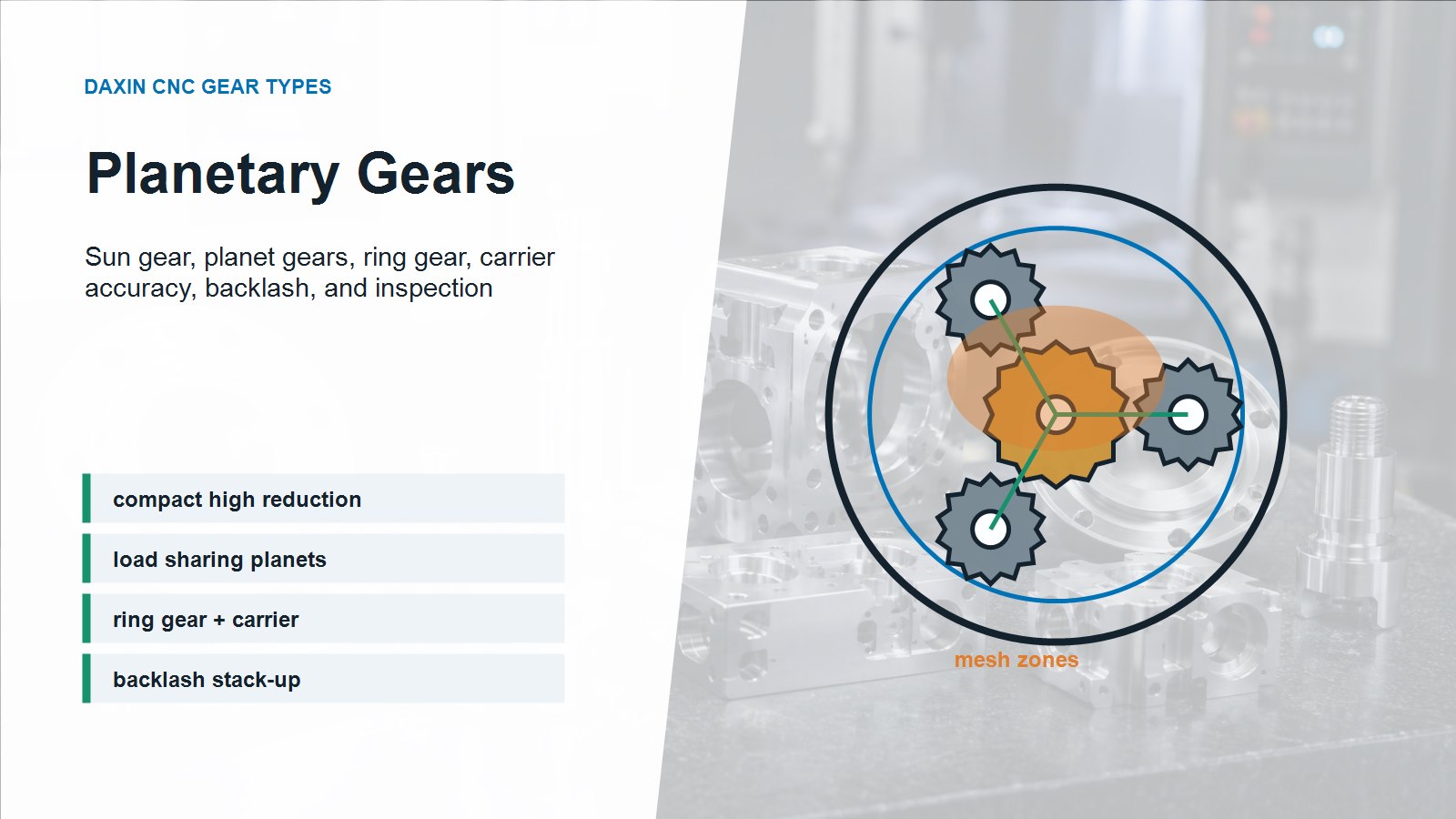
Planetary gears are compact gear systems that combine a sun gear, planet gears, a ring gear, and a carrier to achieve high reduction and high torque density in a small space. Their performance depends on more than individual gear teeth. The real challenge is controlling the whole stack-up: ring gear accuracy, sun gear runout, planet gear bore fit, carrier pin spacing, backlash, contact pattern, bearing alignment, heat treatment, and final inspection.
For CNC machining and gear sourcing, planetary gear sets should be treated as an assembly system. A sun gear, planet gear, and ring gear may each look acceptable alone, but the system can still run noisy or wear unevenly if the carrier and mesh relationships are not controlled.
Key Takeaways
- Planetary gear sets provide compact reduction and high torque density. They are common in reducers, robotics, actuators, motors, gearboxes, and automation systems.
- Load sharing depends on accuracy. Planet gears must share load evenly, which requires precise carrier pins, gear geometry, and alignment.
- Backlash stack-up is more complex than a simple gear pair. Sun-to-planet and planet-to-ring clearances both matter.
- The carrier is a precision machined part. Pin hole position, parallelism, bore accuracy, and face runout affect the whole gear set.
- Inspection should include the assembly relationship. CMM inspection, bore gauge inspection, runout checks, backlash measurement, contact pattern checks, and FAI are important.
What Are Planetary Gears?
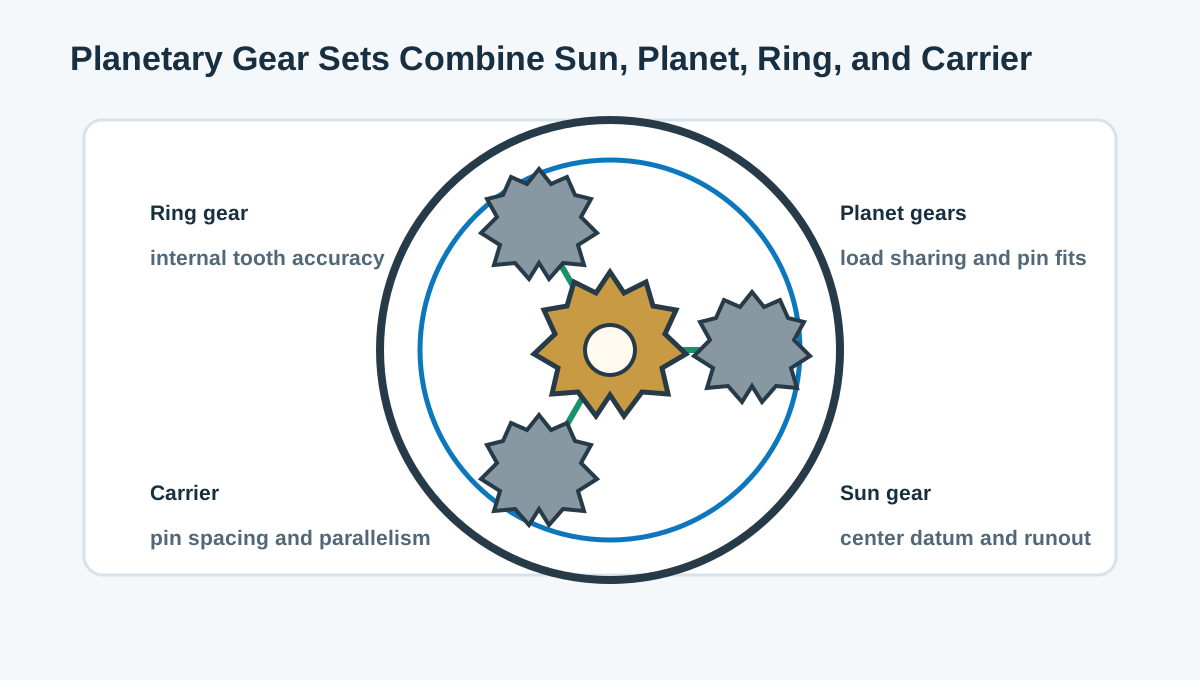
A planetary gear set includes a center sun gear, several planet gears, an outer internal ring gear, and a carrier that holds the planet gears. The planet gears rotate around their own pins and also orbit around the sun gear. Depending on which component is fixed, input, or output, the system can create different reduction ratios and motion paths.
This layout is compact and efficient because several planet gears share the load. It allows high torque capacity in a small diameter compared with many simple gear arrangements. That is why planetary gears are widely used in electric motors, robotics joints, aerospace-style mechanisms, automotive transmissions, servo reducers, actuators, and industrial automation.
Why Planetary Gear Sets Are Hard to Control
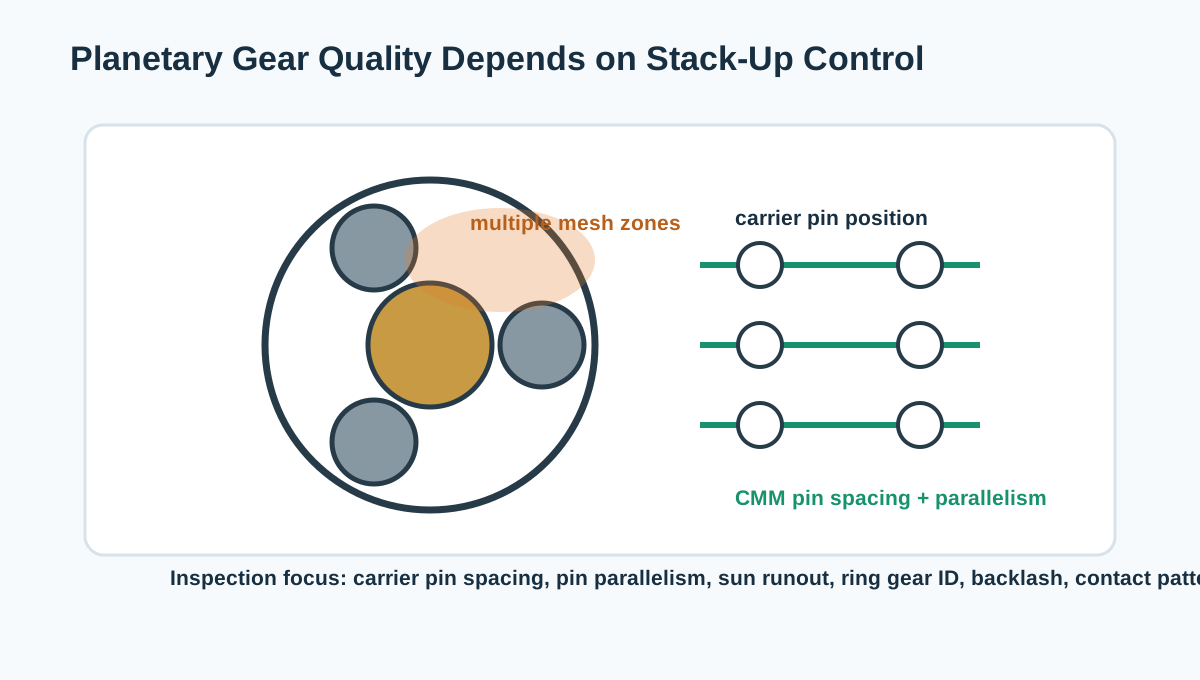
Planetary gears are not difficult only because they have several gears. They are difficult because small errors combine. A small runout error in the sun gear, a small spacing error in the carrier, and a small pitch error in the ring gear can create uneven load sharing. One planet may carry more load than the others, which increases wear, noise, and failure risk.
This is why the carrier, ring gear, and planet pin geometry are just as important as the tooth profiles. A planetary gear set should be inspected as an assembly system, not only as separate parts.
Main Components in a Planetary Gear Set
| Component | Function | Key CNC Machining Concern |
|---|---|---|
| Sun gear | Central gear that meshes with the planet gears | Bore concentricity, tooth runout, shaft fit, heat treatment distortion |
| Planet gears | Gears that rotate around the sun and carry load | Bore size, tooth accuracy, surface finish, matched size consistency |
| Ring gear | Internal gear that meshes with the planets | Internal tooth profile, ID datum, roundness, backlash with planets |
| Carrier | Holds planet pins and transfers output motion | Pin hole position, pin parallelism, face runout, bore accuracy |
The Carrier Is a Precision Part
Many people focus on the gears and forget the carrier. In a planetary gear set, the carrier controls the planet gear locations. If the carrier pin holes are not positioned accurately, the planets will not share load evenly. If the pins are not parallel, the planet gears may tilt and contact the teeth unevenly.
Carrier machining often requires CMM inspection for pin hole position, true position, parallelism, perpendicularity, and face relationship. Bore gauge inspection may be needed for pin holes. Micrometer inspection checks thickness, shoulders, and spacer features. For high-load gearboxes, FAI should confirm the carrier before full production.
Backlash Stack-Up in Planetary Gears
Backlash in planetary gears is more complex than in a simple spur gear pair. Each planet meshes with the sun gear and the ring gear. The clearance at those mesh points affects noise, positioning accuracy, load sharing, heat, and wear.
Too much backlash can create lost motion and impact noise. Too little backlash can cause binding, heat, and uneven load distribution. The correct backlash depends on gear size, accuracy grade, material, lubrication, temperature, and application. For precision planetary reducers, backlash is often a key performance specification.
CNC Machining the Sun and Planet Gears
The sun gear and planet gears may look like small spur or helical gears, but their consistency matters more because several gears work together. If one planet gear has a slightly different bore size, tooth thickness, or runout, load sharing can change.
For these gears, machining and inspection may include gear blank turning, bore finishing, tooth cutting, heat treatment, grinding, bore gauge inspection, runout check, and tooth profile inspection. Surface roughness can also matter because multiple mesh points generate heat and wear.
CNC Machining the Ring Gear
The ring gear is an internal gear, so tooth cutting and inspection are more difficult than for external gears. Tool access, chip evacuation, deburring, and measurement all need planning. The internal tooth profile must mesh correctly with all planet gears.
The ring gear blank should have controlled ID, OD, faces, mounting holes, and datum surfaces before tooth cutting. Heat treatment can distort thin ring gears, so final inspection after heat treatment is important when accuracy matters.
Materials and Heat Treatment
Planetary gear components are often made from alloy steel, carbon steel, stainless steel, bronze, brass, or engineering plastics depending on torque, speed, noise, wear, corrosion, and cost. Load-bearing reducers often use heat-treated steel gears. Low-noise or low-load mechanisms may use engineering plastics for some gears.
Heat treatment improves wear resistance but can also change bore size, runout, and tooth contact. For high-precision planetary gears, final grinding, honing, or lapping may be needed after heat treatment. Hardness inspection and final functional checks help confirm the finished condition.
Inspection for Planetary Gear Quality
Planetary gear inspection should include individual part inspection and assembly-level checks. A complete inspection plan may include:
- CMM inspection for carrier pin holes, ring gear datum, mounting holes, sun gear references, and assembly relationships.
- Bore gauge inspection for sun gear bore, planet gear bores, ring gear datum ID, and carrier pin holes.
- Micrometer inspection for thickness, shoulders, shafts, spacers, and gear blank dimensions.
- Runout inspection for sun gear, planet gears, ring gear, and carrier faces.
- Gear tooth inspection for profile, pitch, lead, and tooth thickness.
- Backlash measurement for sun-planet and planet-ring mesh clearance.
- Contact pattern inspection to confirm load distribution.
- Noise or smoothness check when the application requires quiet operation.
- FAI before batch production to confirm machining, heat treatment, and assembly fit.
Common Planetary Gear Problems
- Uneven load sharing caused by carrier pin spacing error, tooth error, or planet gear variation.
- High noise caused by runout, poor backlash control, rough tooth surfaces, or ring gear distortion.
- Binding caused by insufficient backlash or misalignment.
- Premature wear caused by poor lubrication, rough teeth, heat treatment issues, or overloaded planets.
- Assembly difficulty caused by pin hole errors, tight bores, burrs, or unmatched gear sets.
- Batch inconsistency caused by tool wear, heat treatment distortion, or insufficient FAI.
Design Tips for Planetary Gear Projects
- Define the gear ratio, input/output member, fixed member, and torque requirement clearly.
- Control carrier pin spacing, pin diameter, pin parallelism, and carrier face runout.
- Specify backlash requirements for the complete gear set, not only individual gears.
- Use matched planet gears when load sharing is critical.
- Plan heat treatment and final finishing before production starts.
- Check contact pattern and assembly smoothness before batch production.
- Use FAI to confirm all components work together as a system.
Related CNC Machining Resources
Planetary gears connect closely with internal gears, spur gears, gear blanks, and precision inspection. You may also want to read our guides on internal gears in CNC machining, spur gears in CNC machining, CNC machined gear blanks, and DAXIN’s CNC machining services.
FAQ
What are planetary gears used for?
Planetary gears are used in compact reducers, robotics, electric motors, actuators, gearboxes, transmissions, and systems that need high torque density in limited space.
Why do planetary gears have multiple planet gears?
Multiple planet gears help share load and increase torque capacity. However, load sharing only works well when gear geometry, carrier pin spacing, and alignment are controlled.
What makes planetary gears difficult to machine?
The difficulty comes from the assembly stack-up. Sun gear, planet gears, ring gear, and carrier must all work together, so small errors can combine into noise, backlash, or wear problems.
How is planetary gear backlash checked?
Backlash can be checked between sun and planet gears and between planet gears and the ring gear, often under controlled assembly conditions. Precision reducers may require tighter functional testing.
Final Thoughts
Planetary gears are compact and powerful, but their quality depends on system-level control. Sun gear accuracy, planet gear consistency, ring gear internal teeth, carrier pin position, backlash, contact pattern, heat treatment, and inspection all affect performance. When these details are managed together, planetary gear sets can deliver reliable torque, smooth motion, and compact reduction in demanding mechanical assemblies.