
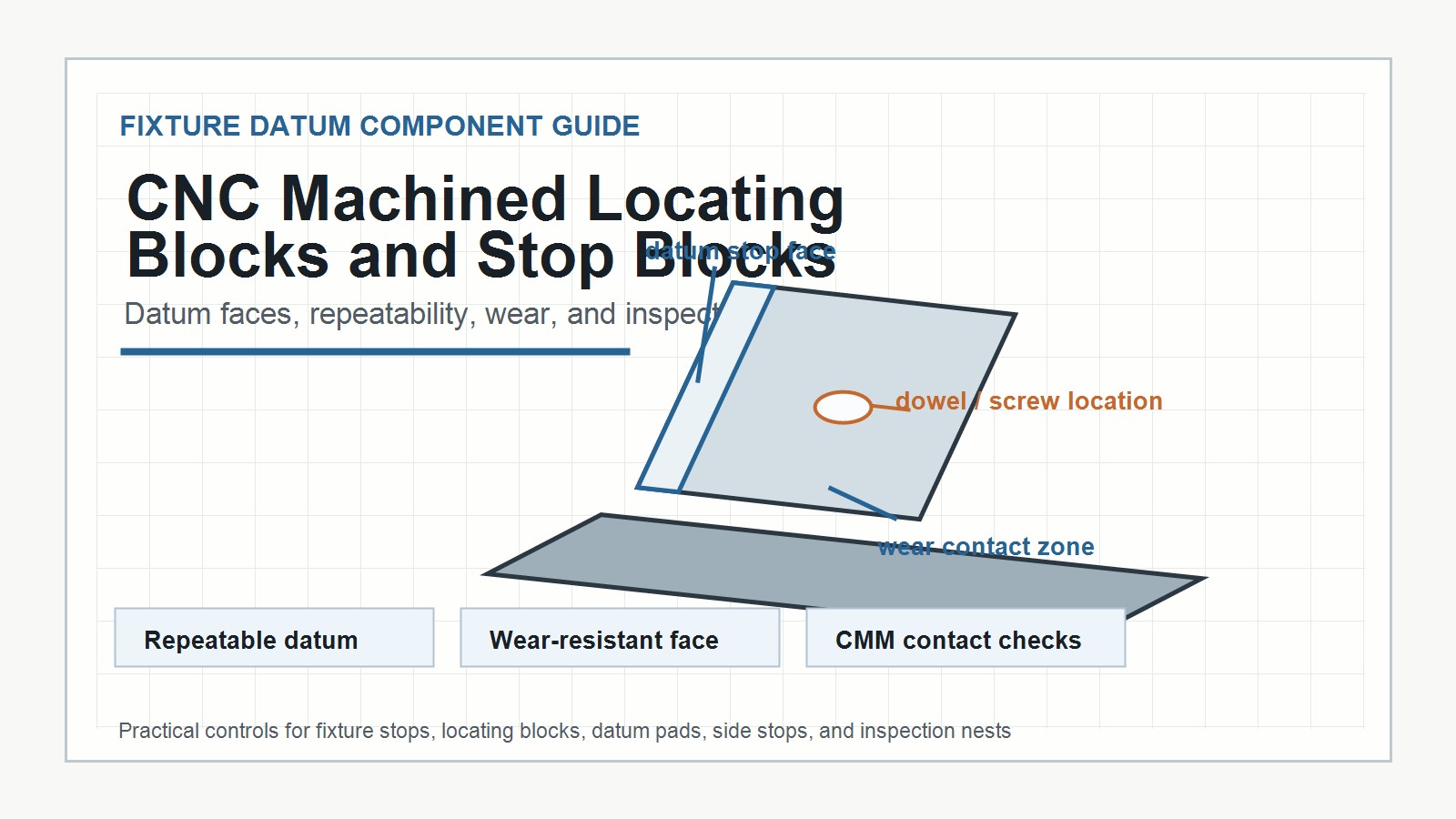
Short answer: CNC machined locating blocks and stop blocks are reliable when datum faces, contact width, perpendicularity, mounting hole position, wear resistance, burr control, and inspection are controlled together. These small fixture parts decide whether a workpiece returns to the same position every cycle.
For buyers, the main risk is treating a stop block like a simple block of material. If the contact face is not square, the dowel holes are off, or the stop face wears quickly, the fixture may slowly lose repeatability even though each block looks acceptable by overall size.
What Are CNC Machined Locating Blocks and Stop Blocks?
Locating blocks and stop blocks are fixture components that provide a repeatable datum for workpieces, inspection nests, assembly tools, and automation pallets. They may act as side stops, end stops, datum pads, adjustable stops, nest blocks, or hardened contact pads.
Their purpose is related to CNC fixture design: locating comes before clamping. A clamp can only hold a part repeatably if the locating surfaces are stable, clean, and correctly positioned.
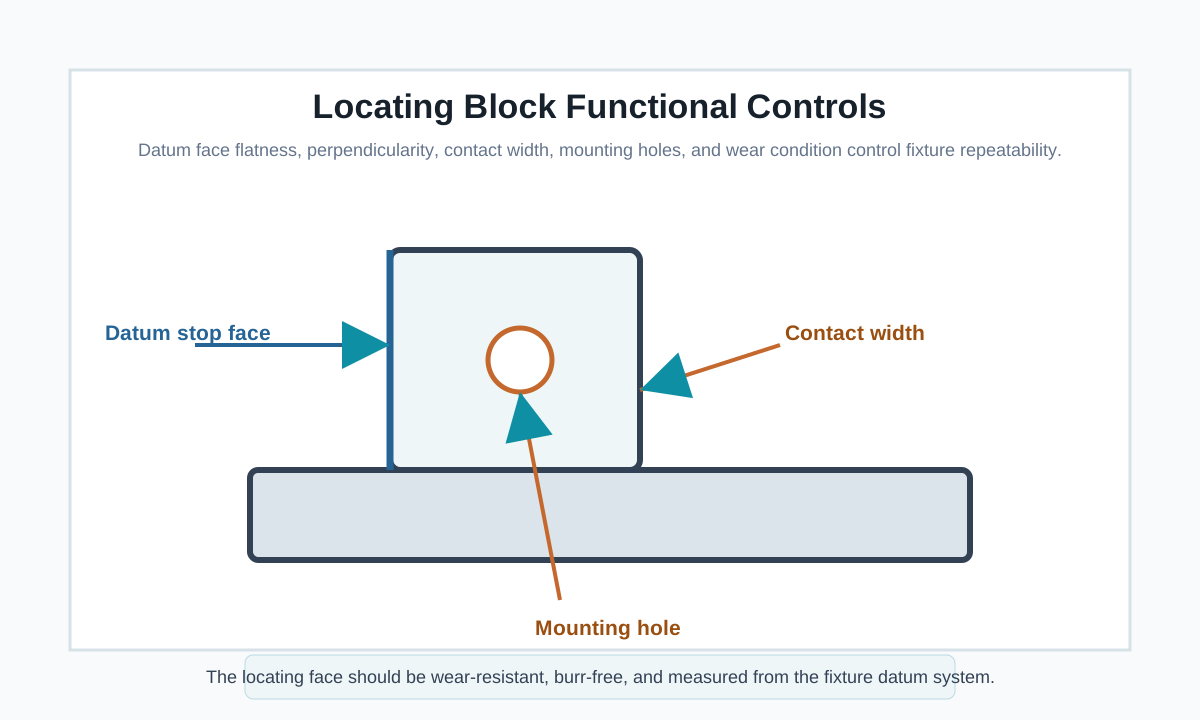
Key Features to Control
| Feature | Common Risk | Factory Control |
|---|---|---|
| Datum stop face | Part shifts or tilts during loading | Control flatness, perpendicularity, and surface finish |
| Contact width | Local wear or unstable support | Define real contact area and avoid sharp fragile edges |
| Dowel and screw holes | Stop block mounts in the wrong position | Inspect hole position from fixture datums |
| Wear surface | Repeatability changes over production runs | Choose suitable material, hardness, or replaceable pads |
| Edge break | Burrs create false contact | Deburr without rounding the datum face |
Datum Faces and Repeatability
The locating face should be machined from the same datum system used in the fixture. If the stop face is measured from a non-functional outside edge, inspection can pass while the workpiece still sits incorrectly in the fixture.
Perpendicularity is important when the block locates against two surfaces or when the workpiece rests on a base plate. A tiny angle error can become a larger position error across a long part.
Wear, Hardness, and Replaceable Pads
Stop faces can wear from repeated loading, chips, sliding contact, or clamping pressure. Aluminum blocks may be fast and economical, but steel, stainless steel, bronze, or hardened inserts may be better for long production runs. If the stop is sacrificial, it should be easy to replace without losing datum position.
Wear planning is similar to CNC machined wear plates and wear strips. The contact material should match the workpiece material, cleaning process, and expected production volume.
Mounting Holes and Adjustment
Locating blocks may use screws, dowels, slots, or fine adjustment screws. Dowel holes provide repeatable mounting, while slots allow tuning. If slots are used, the final locked position should still be verifiable.
Screw seating faces should be flat and burr-free so tightening does not shift the block. Hole-position logic follows the same principles used in CNC hole position tolerance.
Inspection Methods
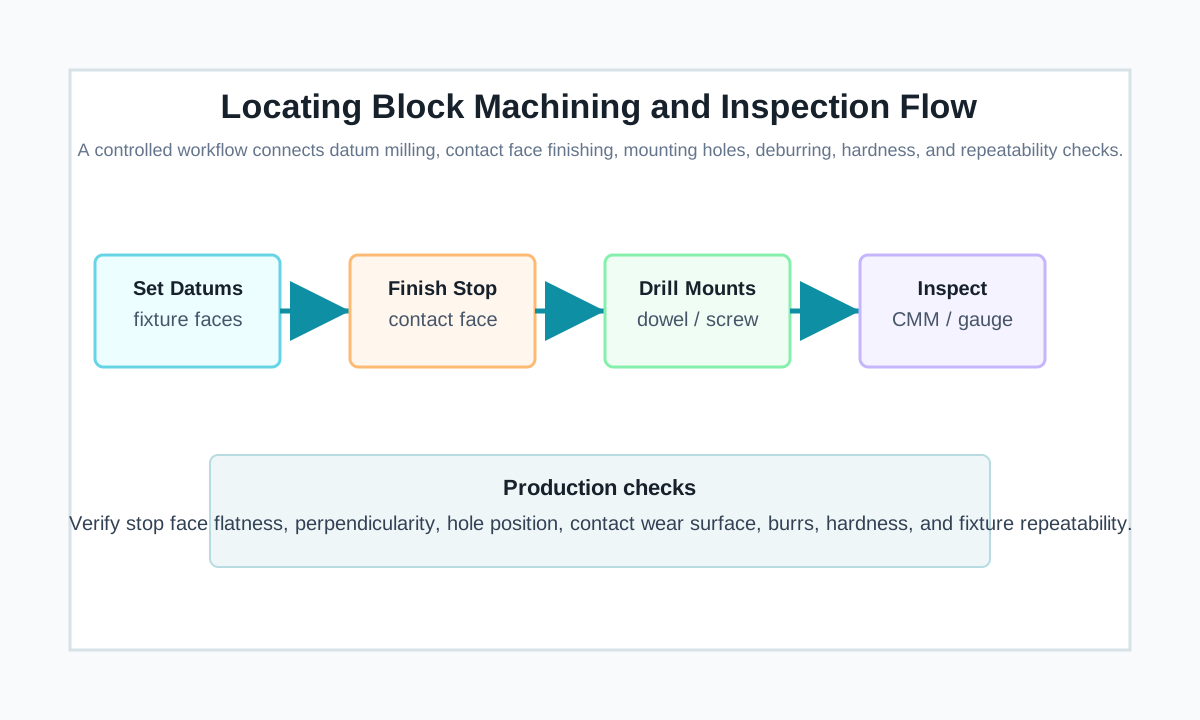
Useful inspection points include stop face flatness, perpendicularity, contact face width, hole position, dowel fit, height from base datum, surface finish, burr condition, hardness, and final location in the fixture. CMM inspection is useful for datum relationships, while functional gauges can confirm repeatable part loading.
For batch production fixtures, the best inspection may include a trial loading check with the real workpiece or master part. That catches contact issues that pure dimensional checks may miss.
RFQ Tips for Buyers
- Identify which face is the functional locating face.
- State whether the stop is fixed, adjustable, replaceable, or wear-resistant.
- Define dowel holes, screw holes, and slot adjustment from fixture datums.
- Choose material and hardness based on workpiece material and production volume.
- Specify edge break carefully so datum faces are not rounded.
- Ask for functional repeatability checks when the block controls batch accuracy.
FAQ
Why do locating blocks need wear-resistant faces?
Repeated loading can wear the datum surface, changing the workpiece position over time. Wear-resistant material or replaceable pads help maintain repeatability.
Should stop blocks use dowel pins?
Dowel pins are useful when the block must be removed and reinstalled repeatably. Slots are better for adjustment but need final position verification.
How are locating blocks inspected?
Common checks include CMM datum relationships, surface plate checks, perpendicularity, hole position, dowel fit, burr inspection, and functional loading checks.
Can deburring affect fixture repeatability?
Yes. A raised burr creates false contact, while over-deburring can round the datum edge. Controlled edge break is important.
Final Thoughts
CNC machined locating blocks and stop blocks are small parts with a large effect on fixture accuracy. By defining datum faces, contact areas, mounting holes, wear resistance, burr limits, and inspection methods early, buyers can keep workholding repeatable across real production batches.