
CNC Sinker EDM is the process buyers usually need when normal cutting tools cannot reach, survive, or leave the required geometry. Milling is fast and flexible, wire EDM is excellent for through-cut profiles, but sinker EDM fills a different gap: blind cavities, sharp internal corners, hardened mold details, ribs, deep pockets, and shapes made by an electrode rather than a rotating cutter.
This guide explains CNC Sinker EDM from a practical sourcing angle. It is not meant to replace CNC milling. It is a secondary precision process that can save a difficult part when the design has features that ordinary machining cannot make cleanly. The decision is about geometry, electrode cost, surface finish, accuracy, material hardness, and whether the feature is worth the extra operation.
Quick Answer
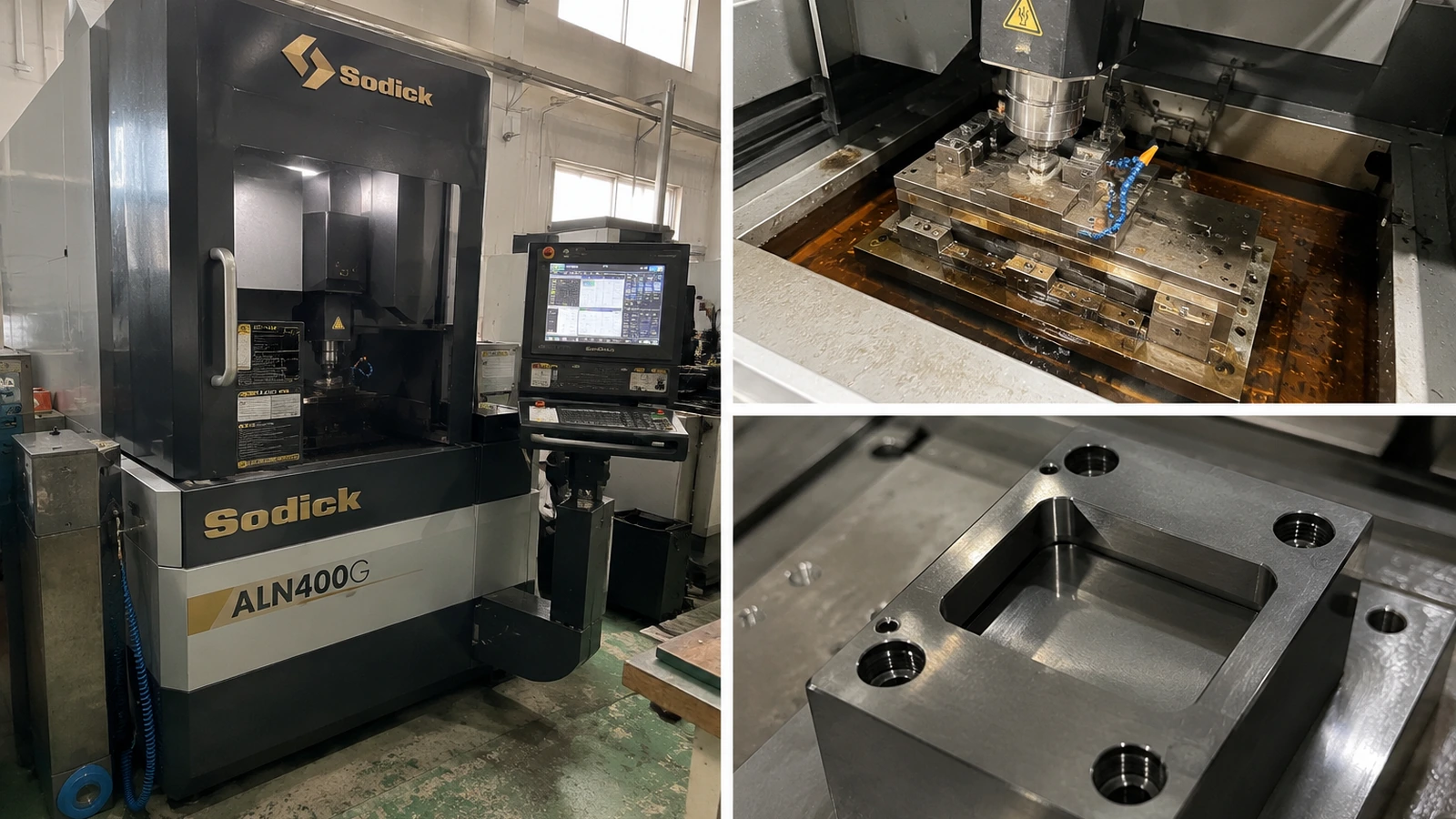
CNC Sinker EDM uses a shaped electrode and electrical discharge to erode conductive material into a matching cavity or feature. It is best for blind cavities, sharp internal radii, deep ribs, mold inserts, hardened steel, and features that are difficult or impossible for end mills to reach. It is slower than milling and requires electrode planning, but it can produce details that cutting tools cannot achieve.
CNC Sinker EDM vs Other CNC Processes
| Process | Best For | Main Strength | Main Limitation |
|---|---|---|---|
| CNC milling | Open pockets, flat faces, holes, 3D surfaces | Fast material removal and flexible machining | Tool radius limits sharp internal corners |
| CNC Sinker EDM | Blind cavities, ribs, sharp details, hardened features | Electrode can form geometry a cutter cannot reach | Slower and needs electrode cost |
| Wire EDM | Through-cut profiles, plates, punches, inserts | Very accurate profile cutting | Needs a through path for the wire |
| Grinding | Flatness, tight surface finish, hardened parts | Excellent finish and precision | Limited geometry flexibility |
How CNC Sinker EDM Works
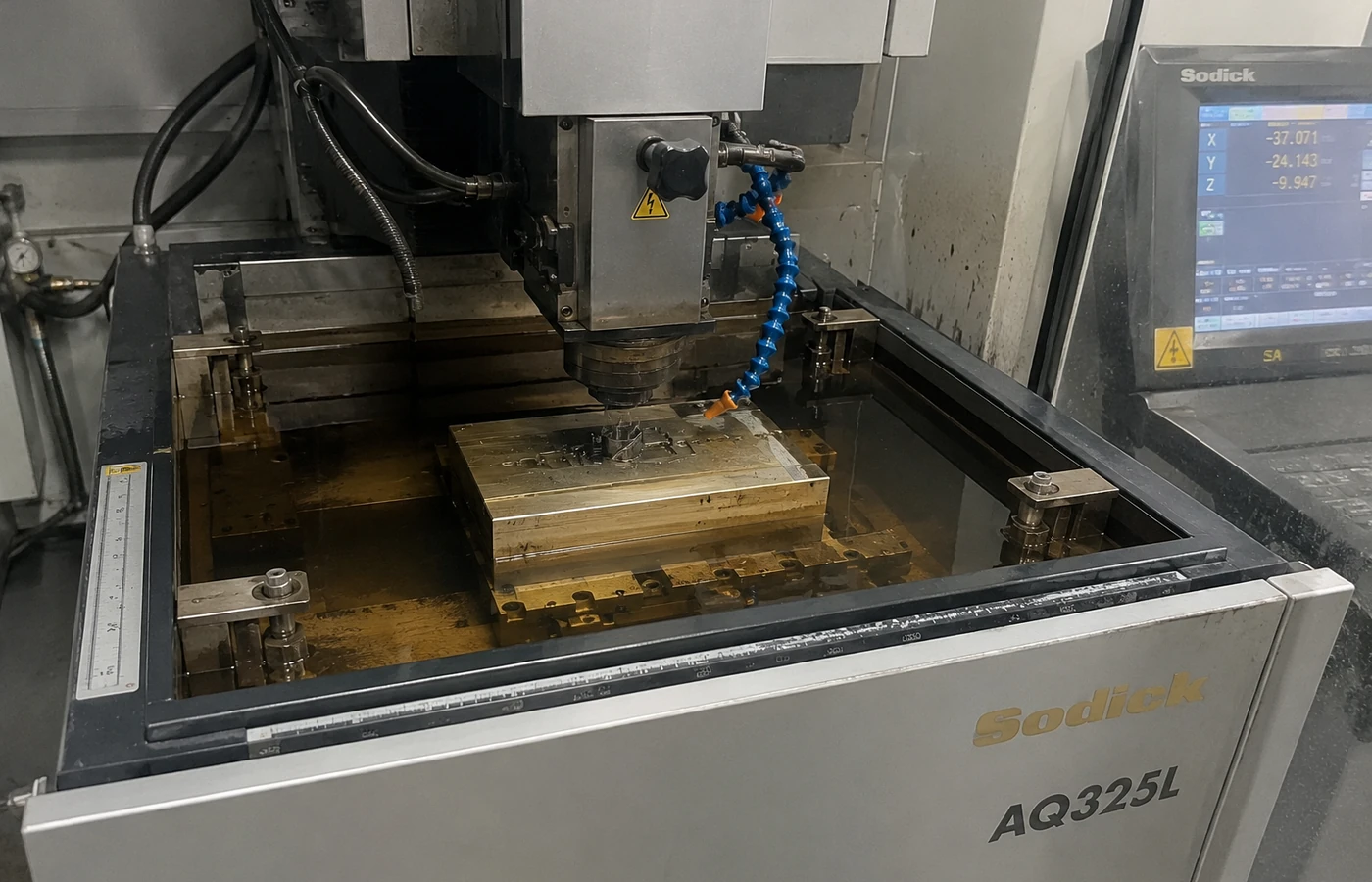
Sinker EDM uses a shaped electrode, usually graphite or copper, that moves toward the workpiece inside dielectric fluid. Electrical sparks jump across a controlled gap and erode the metal surface. The electrode never cuts like an end mill. It burns the shape into the workpiece through repeated discharge.
The electrode shape is the key. If the electrode is shaped like a rib, cavity, logo, corner, or deep detail, the EDM process transfers that geometry into the part. This is why sinker EDM is common in mold making and toolmaking. It can create features that would require extremely long, fragile, or impossible cutting tools.
When CNC Milling Is Not Enough
Milling has one unavoidable limit: the cutter has a radius. If a drawing asks for a perfectly sharp internal corner, a standard end mill cannot create it. The tool also needs physical access. Deep slots, narrow ribs, enclosed pockets, and features under overhangs may be impossible or unstable with rotating tools.
Sinker EDM becomes useful when the design needs those shapes anyway. Instead of forcing milling to do something unsafe or inaccurate, the supplier can rough machine the main cavity, then use sinker EDM to finish the details that cutters cannot reach.
Typical Applications
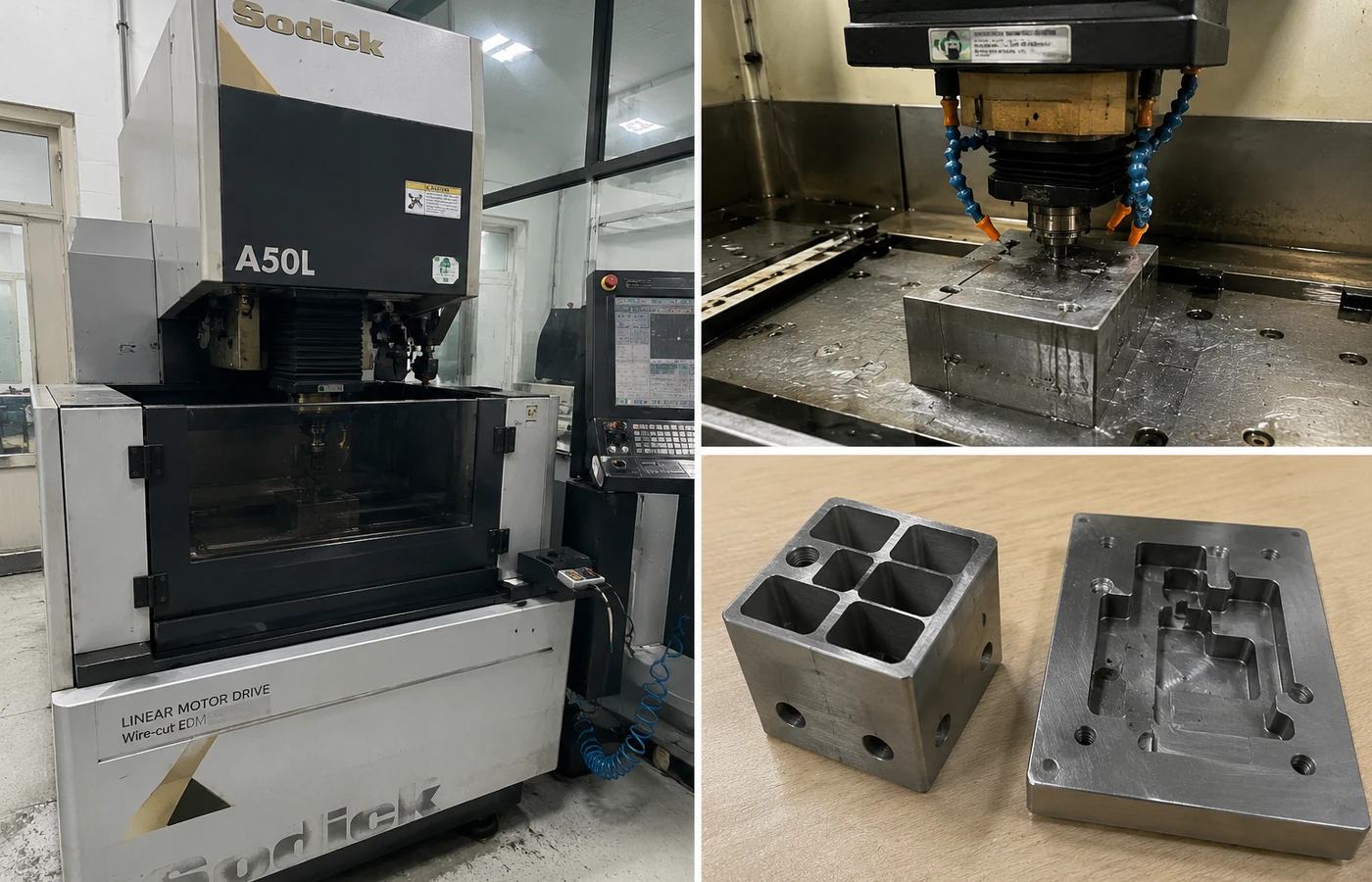
CNC Sinker EDM is widely used for injection mold cavities, die-casting mold inserts, stamping dies, extrusion dies, medical tooling, aerospace tooling, sharp corner features, deep rib features, and hardened steel details. It is also useful on difficult materials if the material is electrically conductive.
In custom CNC work, sinker EDM is usually not the first operation. The part is often milled or turned first to remove most of the material. EDM is then used only where the geometry needs it. This keeps cost under control while still achieving the difficult detail.
Why Electrodes Matter
Every sinker EDM job depends on electrode design. The electrode must include allowance for spark gap, wear, finish, flushing, and geometry. A simple electrode may be quick to make. A complex electrode may become a meaningful part of the quote.
For buyers, this means EDM cost is not only machine time. It includes electrode material, electrode machining, setup, alignment, burn time, inspection, and sometimes multiple electrodes for roughing and finishing. A good supplier will not quote sinker EDM as if it were just a milling pass.
Surface Finish and Accuracy
Sinker EDM can produce controlled surface textures, but the finish depends on discharge settings. A rough burn removes material faster but leaves a rougher surface. A finish burn is slower but leaves a finer result. The correct choice depends on whether the EDM face is cosmetic, functional, sealing, sliding, or hidden inside tooling.
Accuracy also depends on electrode wear, setup, spark gap control, flushing, and material condition. EDM can be very precise, but it is not magic. If the electrode is wrong, the burned feature will be wrong. If flushing is poor, the burn can become unstable or leave an inconsistent surface.
Cost Drivers
| Cost Driver | Why It Matters | Buyer Note |
|---|---|---|
| Electrode complexity | Complex electrodes take longer to design and machine | Simplify details where function allows |
| Burn depth | Deep features take longer and need better flushing | Avoid unnecessary deep sharp cavities |
| Surface finish | Fine finish burns are slower | Specify finish only where it matters |
| Material hardness | EDM handles hardened material well but time still matters | Plan heat treatment sequence early |
| Inspection | Hidden cavities and ribs can be hard to measure | Define inspection method before production |
Sinker EDM vs Wire EDM
Wire EDM uses a moving wire to cut through conductive material. It is excellent for through profiles, punches, plates, slots, and precise 2D shapes. Sinker EDM uses a shaped electrode to burn a cavity or detail into the workpiece. It does not require the same through-cut path as wire EDM.
The simple rule is this: use wire EDM when the feature is a through-cut profile. Use sinker EDM when the feature is a blind cavity, molded detail, sharp internal pocket, or recessed shape. Many mold and tooling projects use both.
Design Tips For Buyers
If you want to avoid unnecessary EDM cost, identify which sharp corners are truly functional. If a corner can accept a normal tool radius, milling will usually be faster. If a rib can be widened, the electrode may become easier. If a cavity can be opened up for cutter access, EDM may become unnecessary.
But do not remove EDM when the function really needs it. For mold shutoffs, small ribs, deep textures, hardened tool steel, and precise blind details, sinker EDM may be the cleanest way to make the part reliable. The goal is not to avoid EDM at all costs. The goal is to use it only where it earns its place.
DAXIN Process View
DAXIN usually treats CNC Sinker EDM as part of a combined process plan. Milling removes the bulk material first. EDM handles the geometry that milling cannot achieve. Inspection then confirms the features that control fit, mold performance, sealing, or assembly. This hybrid approach often gives better cost control than trying to burn the entire part or trying to mill impossible details.
If the part includes mold cavities, hard materials, narrow ribs, or sharp internal details, send the CAD model and drawing early. We can review whether the feature should be milled, EDM finished, redesigned, or split into another manufacturing route.
FAQ
What is CNC Sinker EDM used for?
It is used for blind cavities, sharp internal corners, mold inserts, deep ribs, hardened tool steel details, and features that normal cutters cannot reach.
Is sinker EDM better than milling?
No. It is better only for certain features. Milling is usually faster for open geometry, while sinker EDM is better for difficult cavities and sharp details.
Can sinker EDM machine aluminum?
Yes, if the material is conductive, but sinker EDM is more commonly used where milling limits, hardness, or tooling details justify the process.
Does sinker EDM leave a surface texture?
Yes. The texture depends on the burn settings. Rough burns are faster, while finish burns are slower and smoother.
CTA: Upload Your CAD File / Get a Quote
If your part may need CNC Sinker EDM, upload your CAD file and drawing to DAXIN. We can review sharp corners, ribs, blind cavities, material hardness, electrode cost, CNC milling sequence, and inspection requirements before production starts.
Related DAXIN Services
DAXIN provides CNC machining, mold insert machining, precision milling, EDM-supported machining, prototype parts, low-volume production, hard material machining, and DFM review for features that cannot be solved by milling alone. For related process planning, see our guide to types of CNC machines and our discussion of CNC milling vs turning.